

CHINA
After receiving the Creative New Zealand Creative Fellowship Fund, I had the opportunity to apply for an artist residency in China to further my knowledge of rock glazing. The city of Longquan in southwestern Zhejiang province is renowned for one of the world's most celebrated glazes. Longquan celadon has been produced in the city since the 10th century and is made from the local geology of the region. In Minna Bondys " New Zealand Rock glazes" she sites Chinese glazes as her inspiration to experiment with New Zealand materials and is mentioned in New Zealand potters magazines for producing a New Zealand Celadon glaze. The Longquan Wangou Taoxichuan International Studio residency invites ceramicists to explore Longquan's ancient celadon cultural heritage.


My traveling companions were my wonderful assistant Guan Lun and the glaze technician who is called 'Jin Master' I like to refer to them as 'Little Dragon' and 'Big Dragon' as all three of us are born in the year of the Dragon.


My traveling companions were my wonderful assistant Guan Lun and the glaze technician who is called 'Jin Master' I like to refer to them as 'Little Dragon' and 'Big Dragon' as all three of us are born in the year of the Dragon.
Longquan Wangou Taoxichuan
International Studio residency
The three months I spent in Longquan were deeply enriching. The language of glazing is spoken by everyone, and to be immersed in a city built around my "special interest" strengthened my sense of purpose in the work I do. Preserving the knowledge of those who have come before and honouring tradition are at the heart of life in Longquan, where residents welcome guests from around the world to learn and experience this culture.

I was incredibly lucky that Nanan, a fellow resident at Longquan, happened to be travelling to Hangzhou, where she was a student at the university. I asked if I could join her because I wanted to visit Tianmu Mountain. In a country of 1.4 billion people, her friend from university just happened to be the manager and curator of the Tenmoku Museum, and she arranged for us all to visit that weekend. It was a truly unbelievable chain of events.
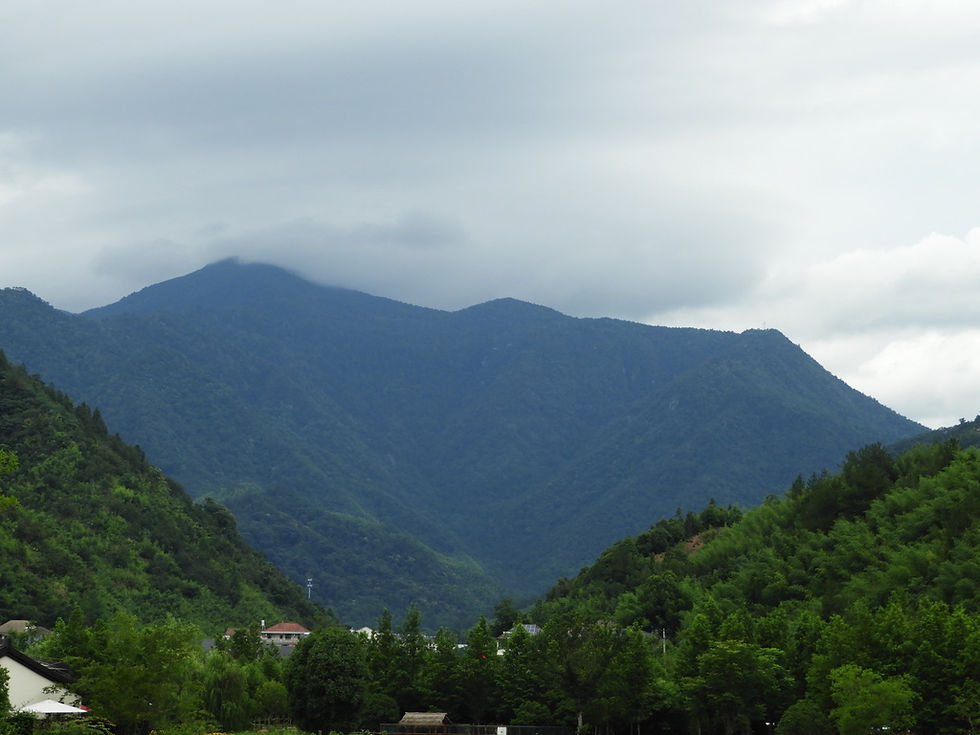
one hour drive from Hangzhou

I was incredibly lucky that Nanan, a fellow resident at Longquan, happened to be travelling to Hangzhou, where she was a student at the university. I asked if I could join her because I wanted to visit Tianmu Mountain. In a country of 1.4 billion people, her friend from university just happened to be the manager and curator of the Tenmoku Museum, and she arranged for us all to visit that weekend. It was a truly unbelievable chain of events.
Residency work
Much of my time in China was spent collecting and processing glaze materials and documenting local sites.
I was also keen to try materials unique to China, such as the prized Dehua porcelain. I had never thrown porcelain before, and it was definitely a steep learning curve. I also wanted to experiment with 3D printing, which was available alongside commercial mould making.
I downloaded the topography of the area where the Longquan glaze stone is sourced and had a mould made of the valley, which I then glazed with rock gathered from that same valley.
Although these materials were foreign, they also felt remarkably familiar. Working with wood ash and simple ingredients, I was able to produce works I am really proud of, while gaining knowledge that has deepened my relationship with the materials of Aotearoa.
Longquan Celadon
In 2020, I travelled the length of New Zealand collecting rock samples, inspired by the work of 1950s studio potter Minna Bondy. Visiting the mountains and rivers where she sourced materials, developing a direct relationship with land and place.
As part of my residency in Longquan, I continued this approach, documenting the traditional sites where celadon materials were sourced, travelling into the surrounding mountains, gathering raw materials and following their journey from mountain to finished piece.


Tianmu Shan
The glaze I use here in Taranaki is often referred to as a 'Temuka' glaze, and early on in my journey, I had no idea why. I then learned that the Japanese word is a translation of Tianmu, "heaven's eye", and comes from a mountain in China where the Tenmouku glaze was first discovered. During the Sung dynasty, monks would travel to the monastery on Tianmu and bring with them their teabowls, which were prized for their unique glaze.
I was lucky enough to travel to Tianmu Shan and the Tenmoku Museum at the base of the mountain and share with the curator more about my own work. We then went to a local site to harvest local materials, very similar to those used by potters in New Zealand.

3D printed Cast Dehua Porcelain Ash Rock Glaze Of and made from the Yuantou Valley, China

Source of glaze for previous work.

3D printed Cast Dehua Porcelain Ash Rock Glaze Of and made from the Yuantou Valley, China